

FAQs About Purchasing Reflective Materials
2024-11-22
Ysmlite
ysmlite.com
Reflective fabric tape
1. How reflective fabric works
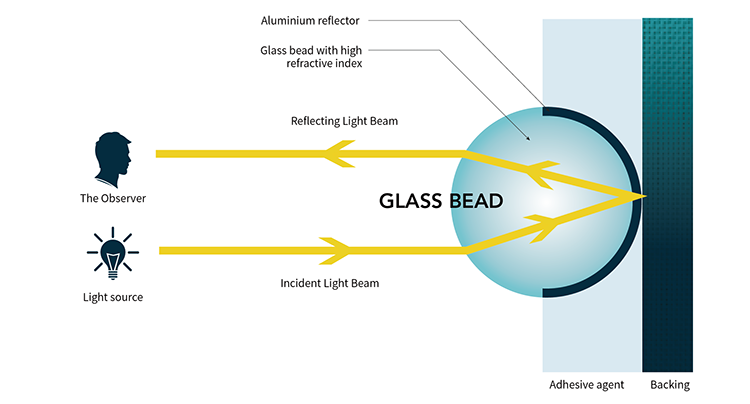
Reflective fabric reflects light through tiny glass beads or micro-prism structures, and uses the principle of light refraction and reflection to reflect light from the incident direction back to the light source. Specific process:
- The light enters the glass beads or micro-prisms.
- It is refracted inside the material and reflected back to the light source.
- The high-brightness retro-reflective effect improves the wearer's visibility in low-light or nighttime environments.
2. How to use reflective heat transfer vinyl
- Preparation: Clean the surface of the substrate to ensure that there is no dust, oil, and moisture.
- Cut the pattern: Use a cutting machine or hand to cut the required pattern according to the design.
- Lay the tape: Attach the adhesive side of the reflective heat transfer vinyl to the substrate.
- Heat pressing: Use a heat press machine at a temperature of 170-190℃ and a pressure of 3-5kg/cm² for 10-15 seconds (the specific parameters are subject to the product description).
- Tear off the protective film: After the hot pressing is completed, wait for it to cool to room temperature and tear off the protective film.
3. How to wash safety clothing with reflective tape
- Water washing: Use room temperature water, choose mild detergent, avoid bleach and softener.
- Industrial washing: If high temperature washing is required, follow ISO6330 or ISO15797 standards, and the recommended water temperature should not exceed 60℃.
- Hand washing: Gently rub the reflective parts and avoid excessive force to avoid damaging the reflective surface.
- Dry cleaning: Dry cleaning can be performed according to ISO3175 standards, but make sure that the reflective fabric is resistant to solvents.
- Drying: Dry at low temperature or air dry naturally, avoid excessive temperatures.
4. Requirements of EN20471
EN20471 is the European standard for high-visibility safety clothing. The main requirements include:
- Reflective performance: The minimum retroreflective coefficient of reflective materials is not less than 330 cd/(lx·m²).
- Visible area: The total area of fluorescent and reflective materials on the garment must meet the requirements of different levels (Class I, II, III).
- Layout and symmetry: The reflective materials should be evenly distributed to ensure 360° visibility.
- Durability: The reflective performance remains stable after washing, friction and aging.
5. Requirements of ANSI/ISEA 107
ANSI/ISEA 107 is the US standard for high-visibility clothing, and the requirements include:
- Reflective coefficient: The minimum reflective performance is 330 cd/(lx·m²), and higher levels may require higher reflective performance.
- Clothing classification: It is divided into Class 1, Class 2 and Class 3 according to the application scenario, covering basic protection to extreme environmental protection.
- Area and color: The garment must be composed of a specific area of fluorescent and reflective materials, and the color is usually fluorescent yellow, orange or red.
- Durability: The material must maintain its performance after industrial washing or severe weather.

6. Basic requirements of industry standards
Industry standards mainly emphasize safety, quality and functionality. Common requirements include:
- Reflective performance: meet the reflectivity of international standards (such as EN20471, ANSI/ISEA 107).
- Durability: The product needs to withstand multiple washing, wear and weather tests (ISO6330, ISO3175, ISO15797).
- Certification qualifications: The product must pass Oeko Tex Standard 100, NFPA 2112 and other certifications to ensure environmental protection and safety.
- Scope of application: The materials and designs of different application scenarios (such as industry, transportation, fire protection) comply with relevant industry specifications.
- Customization capabilities: Special functions (such as flame retardant, perforated, segmented reflective) can be provided according to specific needs.
If you need to know more or have specific needs, please feel free to contact us!

Flame retardant reflective tape
1. What is the difference between cotton flame retardant reflective tape and aramid flame retardant reflective tape?
Base material
- Cotton flame retardant reflective tape: Made of 100% pure cotton material, flame retardant treatment, soft and comfortable, suitable for clothing occasions that come into contact with the skin.
- Aramid flame retardant reflective tape: With 100% aramid as the base material, it has natural flame retardant properties, is lighter and stronger, and has better heat resistance and chemical stability than cotton.
Performance
- Cotton flame retardant reflective tape: Good flame retardancy, but slightly inferior durability in extreme high temperature environments.
- Aramid flame retardant reflective tape: Superior flame retardancy and heat resistance, can withstand instantaneous high temperatures of up to 300°C and above, and does not melt.
Application
- Cotton flame retardant reflective tape: Suitable for daily protective clothing, such as welders, work clothes in industrial manufacturing environments.
- Aramid flame retardant reflective tape: Suitable for higher risk protection areas, such as fire suits, explosion-proof clothing, etc.
Customers can choose according to their own needs.
2. What certificates do your flame retardant reflective tapes have?
- EN20471 Class II Standard
- ANSI/ISEA107-2020
- Oeko Tex Standard 100
- NFPA 2112 (US Standard for Fireproof Clothing)
3. How is the washability of fireproof reflective tape?
- Cotton substrate: up to 50 times of water washing (60℃, ISO6330), or 25 times of dry cleaning (ISO3175).
- Aramid substrate: better resistance in higher temperature industrial washing environment, supporting 25 times of industrial washing (75℃, ISO15797).
The flame retardant properties remain stable after washing, while the reflective coefficient remains at a high level.
4. Can you provide perforated flame retardant reflective tape?
Yes, we can provide perforated flame retardant reflective tape, suitable for enhanced breathability or decorative needs. The perforation style and specifications can be customized according to customer requirements while ensuring flame retardant performance and reflective effect. Please contact our sales staff for more details.
5. What are your flame retardant reflective tapes?
- Cotton flame retardant reflective tape
- Aramid flame retardant reflective tape
- Heat transfer flame retardant reflective tape
- Segmented flame retardant reflective webbing
- Perforated flame retardant reflective tape
If you have specific needs or want more detailed information, please feel free to contact us!

Reflective heat transfer vinyl
1. How to choose the right reflective heat transfer film for your fabric? Is there a free sample?
Choosing the right reflective heat transfer film depends on the following factors:
- Substrate type: Is the fabric polyester, cotton, nylon, elastic fabric or blended material?
- Polyester: It is recommended to choose ordinary reflective heat transfer film.
- Cotton: Suitable for cotton-specific or general-purpose reflective film.
- Elastic fabric: It is recommended to use elastic reflective heat transfer film to avoid peeling or cracking.
- Use scenario: high visibility workwear (high reflective performance required) or sportswear (washability and softness required).
- Color and effect: bright silver, fluorescent yellow, color reflective or segmented style.
We provide free samples for you to test to ensure that it fits your fabric needs!
2. How to heat apply reflective heat transfer film?
Preparation:
- Make sure the surface of the fabric is clean and flat.
- Preheat the fabric to remove moisture and wrinkles.
- Set the heat press parameters (depending on the type of film):
- Temperature: 170-190℃
- Pressure: 3-5 kg/cm²
- Time: 10-15 seconds
Transfer operation:
- Lay the reflective film on the fabric with the adhesive side facing down.
- After heat pressing, wait for cooling and peel off the protective film.
Post-processing:
- Check whether the reflective film is firmly attached and repeat the heat pressing if necessary.
- The detailed technical parameters can be adjusted according to the type of film you choose. We can provide operation manuals and remote guidance.
3. Types of reflective heat transfer films
We provide a variety of reflective heat transfer films, mainly including:
- Bright silver reflective film: high brightness, suitable for safety clothing.
- Colored reflective film: a variety of color options for decoration.
- Fluorescent yellow/orange reflective film: for high-visibility workwear.
- Elastic reflective film: for sportswear, elastic fabrics.
- Flame-retardant reflective film: for high-temperature environments and flame-retardant fabrics.
- Segmented reflective thermal transfer film: for personalized design and breathability requirements.
We can also customize special reflective films according to customer needs.
4. Can I order reflective thermal transfer logos? Are there free samples?
Yes! We support customized reflective thermal transfer logos in various shapes and patterns, which are widely used in workwear, sportswear, footwear, etc.
We provide free samples for testing the effect to ensure that it meets your requirements.
5. What is the minimum order quantity (MOQ) of reflective thermal transfer logos?
Usually, the MOQ of reflective thermal transfer logos is:
- Standard design: 500 pieces.
- Customized pattern: Depending on the complexity, the minimum order quantity is about 1,000 pieces.
If your needs are small, we can negotiate trial production support.
6. Can I customize the segmented reflective heat transfer film in different shapes?
Yes! We can produce segmented reflective heat transfer films according to your design requirements:
- Shape: straight stripes, waves, dots, geometric patterns, etc.
- Spacing: The spacing between the reflective segments can be adjusted.
- Size: Supports customization of width, length and thickness.
- Color: bright silver, color or special fluorescent effect.
Please provide your design draft and we will provide you with detailed solutions and samples.
If you have any other questions or need further information, please feel free to contact us!
Related News

Reflective Webbing Factory: GB 8965 & Global Safety Standards
2026-10-08

Custom High Quality Luminous Film Factory
2026-09-09

Top 5 Flame Retardant Reflective Webbing Tape Manufacturer in Europe
2026-09-07
Messages
* Please be sure to leave your correct information so that we can contact you in time!
Contact us
Address: Wuli Industrial Zone, Jinjiang City, Fujian Province, China
Tel:+86 15980000890
E-mail:jerry@ysmlite.com
