

Analysis of the Principles of Flame Retardant Materials and Reflective Technology
2025-02-28
Ysmlite
ysmlite.com
In the fields of modern clothing, traffic safety, etc., the combination of flame retardant and reflective technology has become the key to improving safety. YSM reflective material manufacturer is committed to providing high-performance flame retardant reflective tapes. Its scientific principles cover the impact of flame retardant types, the brightness and durability comparison of reflective technology, and the synergistic effect of flame retardancy and reflection.
The impact of flame retardant types on tape performance
Flame retardants are chemical additives that prevent materials from burning. Different types of flame retardants affect the performance of tapes, mainly including phosphorus, nitrogen and inorganic flame retardants.
- Phosphorus flame retardants: Phosphorus flame retardants suppress the spread of flames by releasing acidic substances. Its advantage is that it can effectively retard flames at lower usage concentrations, is suitable for a variety of substrates, and can provide strong fire resistance. However, phosphorus flame retardants have poor stability in high temperature environments and may produce harmful gases.
- Nitrogen flame retardants: Nitrogen flame retardants dilute the oxygen concentration in the combustion area by releasing nitrogen, thereby suppressing the spread of flames. They usually have better heat resistance, but their application range is relatively narrow due to their higher cost.
- Inorganic flame retardants: Inorganic flame retardants such as aluminum hydroxide and magnesium hydroxide reduce flame temperature by absorbing heat and releasing moisture, and have strong thermal stability and environmental friendliness. They perform particularly well at high temperatures, but usually require higher dosages, which may affect the softness and comfort of the product.
| Flame retardant type | Mechanism of action | Performance advantages | Limitations | Applicable scenarios |
| Phosphorus flame retardant | Decomposes at high temperature to generate phosphoric acid layer to isolate oxygen | High flame retardant efficiency, strong smoke suppression | May reduce material flexibility | High temperature industrial environment |
| Nitrogen flame retardant | Releases nitrogen to dilute combustible gas when heated | Environmentally friendly and non-toxic, good hydrolysis resistance | Requires high addition (20%-30%) | Outdoor clothing, electronic equipment |
| Inorganic flame retardant | Endothermic decomposition releases water vapor to reduce combustion temperature | Low cost, high stability | Affects material transparency and viscosity | Construction, transportation infrastructure |
The ratio and selection of these flame retardants directly affect the flame retardancy, comfort and cost-effectiveness of the reflective tape. Therefore, the rational selection of flame retardants and their combination with reflective materials are the key to designing high-performance flame-retardant reflective tapes.
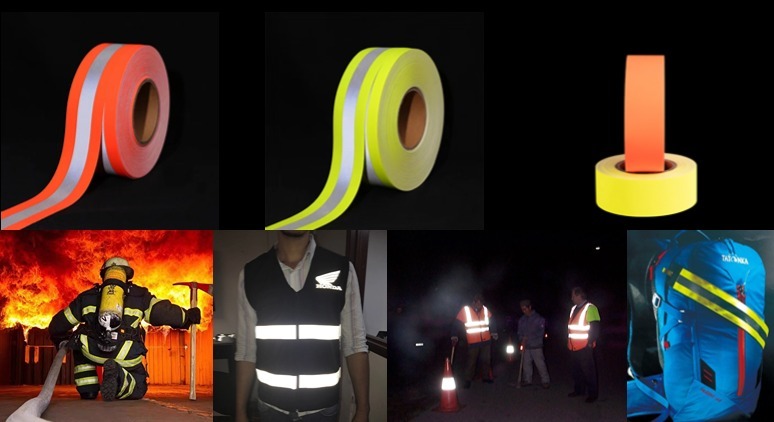
Reflective material technology comparison: microprism vs glass beads
The brightness and durability of reflective tapes mainly depend on the choice of reflective technology, common technologies include microprisms and glass beads.
- Microprismatic technology: Microprismatic reflective materials reflect light back to the source through a series of tiny prism structures, with a high reflective effect. Due to the principle of light reflection through microprisms, microprismatic reflective tapes generally provide stronger brightness than glass bead reflective tapes, especially at longer distances.
- Glass bead technology: Glass bead reflective tape uses the spherical surface of glass beads to reflect light. This technology has a relatively weak reflective effect, but its durability is high, especially for applications exposed to outdoor environments for a long time. Glass bead reflective tapes are generally more economical in cost and suitable for projects with limited budgets.
- Brightness and durability comparison: Microprismatic reflective materials provide higher brightness and viewing distance, suitable for occasions requiring strong reflective effects, while glass beads have an advantage in durability and are suitable for long-term use. Choosing the right reflective technology is crucial to improving safety according to the use environment and needs.
| Parameters | Micro-prismatic technology | Glass bead technology |
| Reflective principle | Precision prism total reflection (reflectivity>90%) | Glass bead refraction and retroreflection (reflectivity 50-70%) |
| Brightness performance | Retroreflection coefficient ≥1000 cd/lx/m² | Retroreflection coefficient ≤500 cd/lx/m² |
| Durability | Scratch resistance, chemical corrosion resistance (lifespan 5-8 years) | Surface wear (lifespan 2-3 years) |
| Applicable environment | Highway signs, fire suits | Ordinary work clothes, temporary warning signs |
Synergy of flame retardancy and reflection: Achievement of double safety
The combination of flame retardancy and reflective functions can significantly improve the safety of the product. Through precise material ratios, flame retardancy and reflective functions can work simultaneously on the same material to provide double protection.
- Key to material ratio: When designing flame-retardant reflective tape, it is necessary to balance the ratio of flame retardant to reflective material. Too much flame retardant may affect the reflective effect, while the addition of reflective material may affect the flame retardant performance. Therefore, a fine ratio can ensure that the tape maintains flame retardant performance while providing reflective brightness, achieving the best safety effect.
- Application scenarios: For example, in traffic signs, work clothes or rescue equipment, flame retardant reflective tape can ensure that personnel are clearly visible in low-light environments, while protecting personnel from fire damage in fire or high-temperature environments. This synergy is essential to improve personnel safety.
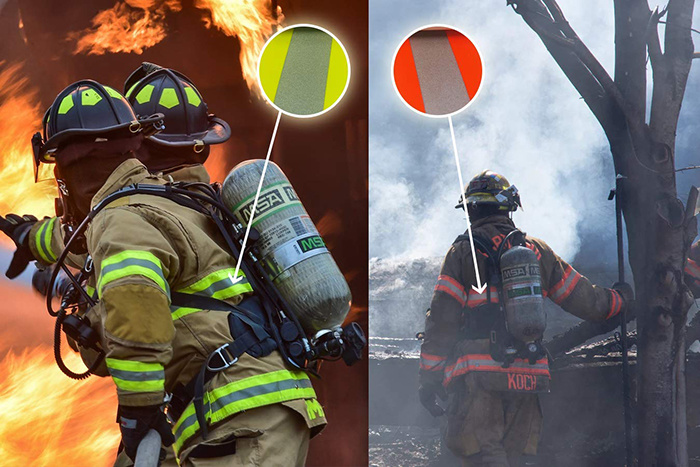
Laboratory testing: combustion experiments and measured data of reflective coefficients
In order to verify the effectiveness of flame retardant and reflective properties, laboratory testing is essential.
Combustion experiment: By simulating different fire sources and temperature conditions, the fire resistance of flame retardant tapes in fire is tested. Experimental data show that tapes using phosphorus and nitrogen flame retardants have longer self-extinguishing time and lower flame propagation speed during combustion, effectively preventing the spread of fire.
Reflective coefficient measurement: The reflective performance of the tape under different lighting conditions is evaluated by measuring the reflective coefficient. The reflective coefficient of microprismatic reflective tape is significantly higher than that of glass bead materials, which can ensure visibility at longer distances and in lower lighting conditions.
These experimental data help industry personnel to more accurately select the appropriate flame-retardant reflective tape to ensure that it achieves optimal performance in actual applications.
The combination of flame retardant and reflective technology can not only effectively improve safety, but also ensure protection in various harsh environments. By deeply understanding the types of flame retardants, the technical selection of reflective materials, and the synergy between the two, buyers and industry safety personnel can better choose suitable reflective tape products. YSM reflective material manufacturers provide you with high-performance flame retardant reflective tape to meet the needs of different application scenarios and help improve the safety of the working environment.

Related News

Reflective Webbing Factory: GB 8965 & Global Safety Standards
2026-10-08

Custom High Quality Luminous Film Factory
2026-09-09

Top 5 Flame Retardant Reflective Webbing Tape Manufacturer in Europe
2026-09-07
Messages
* Please be sure to leave your correct information so that we can contact you in time!
Contact us
Address: Wuli Industrial Zone, Jinjiang City, Fujian Province, China
Tel:+86 15980000890
E-mail:jerry@ysmlite.com
