

Is Heat Transfer Reflective Film Suitable for Any Climate Conditions?
2024-02-17
YSM
YSMLITE
With the growing demand for safety protection and high-visibility clothing around the world, the application range of reflective materials is becoming increasingly wide, from road construction, safety clothing to outdoor sports equipment, all of which reflect its importance. In these usage scenarios, thermal transfer reflective film has become the mainstream choice due to its good softness, processability and high reflectivity. However, in the changing and even extreme climate environment around the world, whether thermal transfer reflective film can cope with various conditions has become a key issue for purchasers and users.
For example, the hot weather of up to 50℃ in Saudi Arabia, the severe cold of minus 40℃ in Siberia, Russia, the high humidity in the rainforests of Southeast Asia, and the strong ultraviolet radiation in Australia in summer... These environments are great tests for the physical properties, bonding properties and durability of reflective film.
What is heat transfer reflective film? Working principle and structural analysis
Reflective heat transfer film is a reflective material used on flexible substrates such as cloth. The reflective film is bonded to the target surface by heating and pressurizing. This film material is composed of a multi-layer structure, and common structures include:
- PET release film: As the outermost layer, its main function is to carry and protect other layers, and it is torn off during transfer.
- Hot melt adhesive layer: determines the adhesion strength between the reflective film and the substrate, and different uses correspond to different viscosity and melting point formulas.
- Reflective layer: usually composed of glass beads or microprisms, responsible for reflecting light, is the key to reflective intensity.
- Protective coating/ink layer: plays an anti-oxidation, anti-scratch, anti-UV and other roles.
Compared with traditional sewing reflective strips, thermal transfer reflective film has the advantages of being thinner, seamless, good fit, and does not affect the elasticity of the fabric. It is very common in modern occupational protective clothing and sportswear.
However, it is also more sensitive to environmental conditions. Different climatic conditions may cause aging of the adhesive layer, shedding of the reflective layer, fading of the film surface, cracking, etc., so material selection and application methods are crucial.
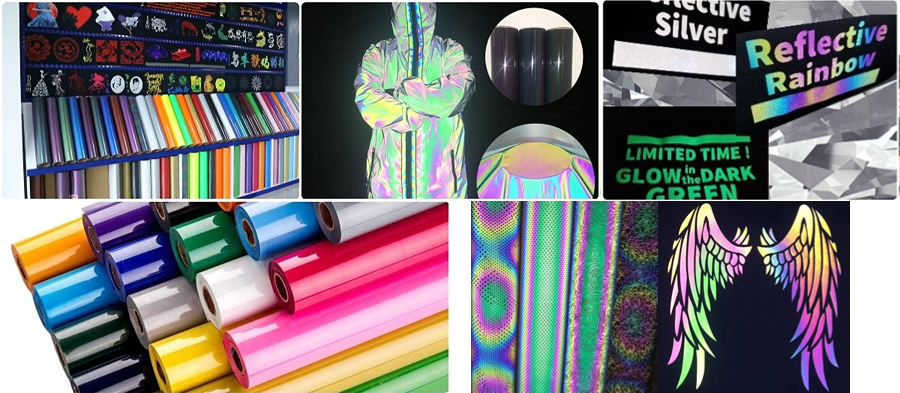
The impact of different climate types on the performance of heat transfer reflective film
To determine whether thermal transfer reflective film is suitable for all climate conditions, we first need to understand the problems it may face in various typical climate environments.
High temperature and dry climate (such as the Middle East, Africa, and Australia)
At surface temperatures exceeding 45°C or even reaching 60°C, ordinary hot melt adhesive layers may soften, causing the edges of the reflective film to warp, bubbles, or even the entire piece to fall off. In addition, high temperatures may also accelerate the aging of the resin inside the reflective layer, causing it to lose its due brightness.
Extremely cold climate (such as Northern Europe, Canada, and Russia)
When the temperature drops below -20°C, part of the hot melt adhesive layer may lose its flexibility and become brittle, and the reflective film after thermal transfer is prone to cracking. If the raw materials of the reflective layer of the microprism structure do not pass the low temperature test, there will also be problems of peeling or breaking.
High humidity rainforest climate (such as Indonesia, Vietnam, and the Amazon region)
High humidity poses a challenge to the bonding strength of the reflective film. If the adhesive layer has poor moisture resistance, it is easy to debond and mold over time, affecting the service life. At the same time, under hot and humid conditions, the film is more likely to breed bacteria, affecting the hygiene of clothing.
Areas with strong ultraviolet rays (such as Australia and South America)
If the reflective film lacks anti-ultraviolet coating protection, it may fade and turn yellow if exposed to strong UV environment for a long time, and the reflective performance will be significantly reduced.
Sandstorm, snowy climate (such as Mongolia and Alaska)
The wind force under harsh natural conditions is mixed with sand or ice crystals, causing wear and even damage to the film surface. If the film layer is not hard enough, it is easy to produce scratches and reduce the visual recognition effect.
In summary, the impact of climate on thermal transfer reflective film is not a single factor, but a comprehensive test of high temperature, low temperature, humidity, ultraviolet rays, and physical impact. High-quality reflective film must have composite properties to be competent for changing climates.
How to evaluate the climate adaptability of reflective film? Test methods and international standards
To determine whether a reflective film can be used in a variety of climate environments, it is necessary to use authoritative standards and laboratory testing tools. The following are several test methods widely used in the industry:
- UV accelerated aging test (ASTM G154 / ISO 4892): simulate long-term exposure to solar ultraviolet rays to observe the color change and brightness decay of the film.
- High and low temperature cycle test: the film is repeatedly heated and cooled between -40℃ and +80℃ to verify whether its thermal expansion and contraction performance is stable.
- Wet heat aging test (85℃, 85% RH, 1000 hours): test the adhesion and appearance changes of the film in an extremely humid and hot environment.
- Reflective brightness test (EN 20471 RA value determination): evaluate whether the reflective ability of the film surface maintains the standard brightness.
- Adhesion test (ISO 2411): detect the peel strength between the adhesive layer and the fabric or other substrate to see whether it meets the fastness at different temperatures.
- OEKO-TEX® Standard 100: whether it contains substances that are harmful to the human body or skin, especially whether harmful substances will be precipitated in high temperature and high humidity environments.
International high-end manufacturers, such as YSM, 3M, and Orafol, usually equip themselves with a full set of experimental equipment for internal testing, and at the same time pass the certification of third-party authoritative organizations to ensure that the reflective film can cope with various extreme environments.
Application cases of heat transfer reflective film in extremely cold and high temperature environments
The following are several real application scenarios from YSM customers, which verify the actual adaptability of thermal transfer reflective film in extreme environments:
Russian Siberian Extreme Cold Work Clothing Project
- Use environment: average -30℃ in winter, as low as -45℃
- Project description: Provide high-visibility warm clothing for natural gas pipeline construction workers
- Test results: The thermal transfer reflective film remains soft and crack-free, and the RA value remains at the normal reflective standard
UAE Traffic Police Uniform Project
- Use environment: outdoor temperature in summer Temperature exceeds 50℃, direct sunlight
- Project description: Provide all-weather high-brightness reflective strips for traffic control clothing
- Results: The reflective film has no bubbles, the edges do not curl, and the brightness decay is less than 5% after three months
Indonesian motorcycle rider reflective clothing project
- Use environment: Annual average humidity is above 85%
- Project description: Need to withstand rain erosion and long-term high humidity storage
- Test results: After thermal transfer, the reflective film is firmly bonded, without degumming, and the reflectivity is stable
These measured data show that as long as high-quality reflective film is selected and constructed according to specifications, it can maintain excellent performance even under extreme climatic conditions.

How to correctly choose heat transfer reflective film suitable for multiple climate environments?
Not all thermal transfer reflective films have "universal" capabilities. Before purchasing or designing, the following points are particularly important:
- Pay attention to the weather resistance grade logo: high-quality products usually indicate that they have passed relevant environmental adaptability tests such as ASTM, ISO, EN, etc., especially the temperature range and UV aging level.
- Adhesive layer formula: Reflective film suitable for extremely cold or high humidity environments. The glue must have low temperature resistance and moisture resistance. Different adhesive types (such as PU glue, thermoplastic TPU, etc.) should be used for different climatic conditions.
- Base fabric matching: Fabric selection also needs to be considered simultaneously. It is recommended to match with functional fabrics that have been treated with waterproof, windproof, and UV protection to enhance the overall weather resistance.
- Application scenario analysis: For traffic duty, riot clothing, mining uniforms, etc., composite high brightness + high fastness + high flexibility product types should be selected; while ordinary clothing or cycling equipment can flexibly weigh performance and cost performance.
- Avoid blindly purchasing cheap products: There are a large number of uncertified low-priced reflective films on the market. They may have no obvious problems in the initial use, but they cannot withstand the long-term test of the environment, which will eventually lead to rapid aging, shedding and even safety hazards of reflective clothing.
Manufacturers such as YSM can recommend the most suitable reflective film model combination based on the climate data of the customer's country and the type of application clothing to achieve "customized safety protection" in the true sense.
YSM's multi-climate adaptability advantage of heat transfer reflective film
As a professional high-performance reflective material manufacturer in China, YSM always adheres to high standards in the climate adaptability design of thermal transfer reflective film. The following are YSM's key advantages:
- Full-process independent research and development: including reflective slurry ratio, coating bonding, release film development, coating structure design, etc., to ensure that each link is controllable and of high quality.
- Extensive climate test coverage: Through independent laboratories, YSM has completed 6 typical climate simulation tests in the world, covering temperature -40℃ to +85℃, UV>400 hours, and wet heat>1000 hours of cycle verification.
- High bonding strength adhesive layer technology: Develop a variety of hot melt adhesive systems according to application requirements, including adhesive types suitable for different substrates such as polyester, nylon, and elastic fibers.
- Complete professional certifications: The products have passed international certifications such as OEKO-TEX®, REACH, ROHS, EN 20471, etc., to ensure environmental protection, non-toxicity, and stable performance.
- Customers cover global climate zones: Products are widely used in the extremely cold regions of North America, hot and humid countries in Southeast Asia, and high-temperature and dry markets in Arabia, all of which perform well, with a large number of customer feedback and repeat orders.
Correct construction and maintenance: Improve the performance of reflective film in extreme environments
Even the best reflective film may suffer performance degradation if it is improperly constructed or used. The following are the construction and use tips recommended by YSM:
Thermal transfer temperature control: The transfer temperature of different film materials is generally between 130℃ and 150℃, which needs to be accurately set according to the product instructions and should not be too high or too low.
- Pressure and time matching: The pressure is recommended to be controlled at 35kg/cm² and the time is between 512 seconds to avoid insufficient time resulting in weak bonding and overheating to burn the base.
- Avoid air inclusion: The fabric must be completely flattened before transfer, and there must be no moisture or impurities, otherwise bubbles and peeling will occur.
- Washing precautions: It is recommended that the water temperature does not exceed 40℃, bleaching and dry cleaning are not allowed, and high-temperature drying should be avoided to extend the service life of the reflective film.
- Regular inspection and maintenance: If used in a high-intensity working environment, the reflective film area should be replaced or supplemented regularly to maintain high visibility.

In summary, thermal transfer reflective film is not naturally "suitable for any climate". Its true environmental adaptability depends on the material, structural design, adhesive technology, and actual construction and application methods of the film itself.
Driven by professional reflective materials manufacturers such as YSM, modern thermal transfer reflective film can remain flexible in an extremely cold environment of -40℃, does not melt or bubble at a high temperature of 50℃, and maintains color stability and lasting brightness under high humidity and strong ultraviolet conditions. As long as the correct selection and construction are carried out, it can indeed be "suitable for almost any climate".
For corporate customers, it is recommended to give priority to reflective film brands that have been certified by international standards and have rich actual testing experience and customization capabilities to ensure the safety, durability and cost-effectiveness of the product.
Related News

Reflective Webbing Factory: GB 8965 & Global Safety Standards
2026-10-08

Custom High Quality Luminous Film Factory
2026-09-09

Top 5 Flame Retardant Reflective Webbing Tape Manufacturer in Europe
2026-09-07
Messages
* Please be sure to leave your correct information so that we can contact you in time!
Contact us
Address: Wuli Industrial Zone, Jinjiang City, Fujian Province, China
Tel:+86 15980000890
E-mail:jerry@ysmlite.com
