

How to Use Glow in Dark Film
2024-09-11
YSM
YSMLITE
| Table of Contents |
2. Reasons why luminous film glows |
Yeshiming Company is one of the top luminous film factory in China, with a history of 26 years and a certain influence in the local area. The photoluminescent film produced by Yeshiming has passed the German DIN standard test, and the quality is trustworthy.
In modern home decoration, emergency signs and outdoor activities, luminous film is becoming more and more popular due to its characteristics of "absorbing light during the day and emitting light at night". As an expert in luminous film manufacturing, YSM will rely on years of production experience, combined with authoritative data and practical skills to help you fully master the use of luminous film from "why to use" to "how to use it well".
What is luminous film
Luminous film is also called light-storing film. Now we can find luminous film in the luminous signs of buildings, decoration, advertisements, traffic signs, artificial landscapes, hotels, shopping malls and special occasions, fire safety signs, ship safety signs and other guide and identification signs. Its use has been integrated into everyone's life.
The reason why the luminous film glows
However, luminous film cannot emit light by itself. Its luminous principle is that the main component is rare earth, which works by absorbing light-storing light-self-luminescence. It only needs to absorb and store natural light and artificial light energy for a period of time, and it can be used as a light source at night and in a lightless environment without electricity.
The reason why luminous film can be "bright as day at night" is due to the phosphor particles in it.
- Absorbing energy: During the day or under ultraviolet light (UV light), phosphor absorbs visible light and ultraviolet energy.
- Storage process: This energy is "captured" by the internal structure of phosphor to form an excited state.
- Release photons: When the surrounding environment is dark, phosphor releases the stored energy in the form of photons, producing continuous fluorescence.
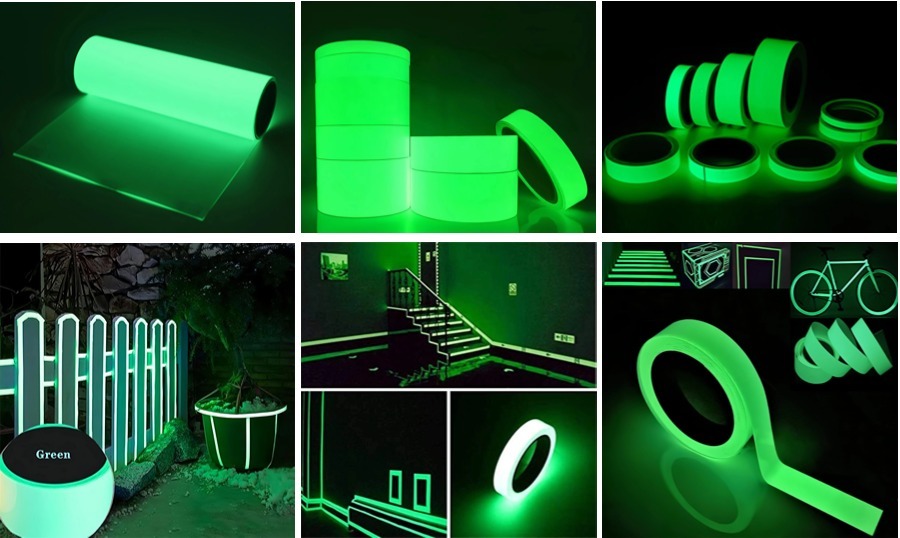
The luminous material we use to make tape is non-toxic and does not contain any phosphorus or radioactive substances. When the lights are off, the luminous tape will emit a strong photoluminescent reaction, which can illuminate the edges of stairs, door frames, sidewalks, stairs, skirting boards, entrance, exit passages and any other places that require strong light and no electricity. The light-storing film can indeed glow for 12 hours at night and will be very bright in the first 4 hours after dark, but the brightness will decrease over time. In actual use, the human eye will gradually adapt to the dark environment and will not feel a significant decrease in brightness.
How to choose high-quality luminous film
When choosing glow in the dark film, the following points can best reflect professionalism:
Phosphor composition
- Commonly used are zinc sulfide doped with copper (ZnS:Cu) or silicates (SrAl₂O₄:Eu).
- Silicates glow more persistently and are commonly used in safety signs.
Film substrate
- Polyvinyl chloride (PVC) is soft and easy to stick; polyester (PET) is heat-resistant and aging-resistant.
Thickness and transmittance
- The thicker the film, the more light absorption and energy storage, but the transmittance must take into account the clarity of printing or pattern.
Environmental protection and certification
- Whether it has passed environmental protection tests such as RoHS and REACH to ensure that there is no excessive heavy metal content.
How to use the luminous film
Preparation:
- Make sure the surface of the substrate (such as clothing, walls or other objects) is clean, flat, and free of dust or oil.
- Wipe the substrate with a clean rag or alcohol to ensure that it is completely dry.
Cut the luminous film:
- Use scissors or a cutter to cut the luminous film according to the required size and shape.
- It is recommended to leave an extra 0.5~1cm edge when cutting to avoid insufficient subsequent pasting.
Paste the luminous film:
- Self-adhesive luminous film: Tear off the release paper on the back and gradually stick it to the surface of the substrate from one side.
- Heat transfer luminous film: Place the luminous film pattern side up and cover the surface of the target object.
Pressure treatment:
- Use a scraper or roller to evenly scrape from the middle to the surrounding area to remove bubbles and ensure that it is firmly pasted.
Fixing (thermal transfer type):
- Use a heat press or iron to heat the transfer according to the temperature and time recommended by the manufacturer, usually 130-150℃, 15-20 seconds.
- After the luminous film cools down, gently tear off the surface protective film.
How to use luminous film in various scenarios
Home decoration
- Stair step edge: Automatically glow at night to prevent tripping.
- Switch panel: Easily find the switch position after a power outage.
Safety signs
- Evacuation instructions: Fixed arrows are posted on the walls of hotel and cinema corridors to improve safety.
- Emergency equipment: The edges of the shells of fire extinguishers, first aid kits, etc.
Outdoor activities
- Campground: Around the tent, route guidance.
- Cycling equipment: Handlebars and helmet stickers to enhance night visibility.
Creative handicrafts
- DIY wall stickers: Add fun to the room.
- Toy models: Luminous stars, puzzles.
Precautions for using luminous film
Substrate requirements:
- Make sure the surface of the substrate is flat and has no bumps, otherwise it will affect the pasting effect.
- It is not recommended to use on surfaces such as silicone and rubber, because these materials will affect the adhesion of the luminous film.
Temperature control (heat transfer type):
- When using a heat press, be sure to operate at the recommended temperature. Too high a temperature will cause the luminous film to deform, and too low a temperature will not be firmly adhered.
- Apply pressure evenly during ironing to avoid local overheating or loose pasting.
Bubble removal:
- If bubbles are found during pasting, use a needle to pierce them and then scrape them flat to avoid affecting the appearance and luminous effect.
Environmental conditions:
- The storage and use environment of the luminous film should be kept dry to avoid high humidity causing a decrease in viscosity.
- It is not suitable to paste in an environment below **10℃ or above **40℃. Too low a temperature will affect the viscosity of the glue.
Cleaning and maintenance:
- The surface of the luminous film can be gently wiped with a damp cloth, but avoid using chemical solvents such as strong acids and alkalis.
- When cleaning objects with luminous film, avoid spraying high-temperature steam directly on the film to prevent it from falling off.
Light source activation:
- Before use, the luminous film should be exposed to strong light for a period of time to ensure that it achieves the best luminous effect in a dark environment.
Importance of luminous film
Improve safety
"Continuous glow" in key areas can also guide directions when there is no electricity or power outage.
Energy saving and environmental protection
"Absorb light" during the day and glow at night, no additional power supply is required.
Enhanced experience
Homes and public places are both practical and beautiful, bringing fun.
Controllable cost
Compared with the arrangement of emergency lighting fixtures, luminous film has lower investment and simple maintenance.
Common problems and solutions
Problem
|
Cause Analysis
|
Solution
|
| Luminous film falls off | The substrate surface is not clean or the temperature is not enough | Clean the surface and re-press or heat to paste |
| There are bubbles or wrinkles | Bubbles were not removed during pasting, or the pasting was uneven | Puncture the bubbles and scrape it flat, or re-paste |
| Luminous effect is not good | Insufficient activation or insufficient exposure to light | Expose to strong light for more than 30 minutes in advance to activate |
| The edge is warped or cracked | The substrate surface is not pressed firmly during pasting, or the high temperature environment affects the viscosity | Heat and re-fix, or use glue to remedy |
Attached is the parameter table of YSM's luminous film
| A | B | C | D | |
| Glowing Time | 4-6h | 6-8h | 8-12h | >12h |
| Regular Size | 1.22m*45.7m/roll | 1.22m*45.7m/roll | 1.22m*25m/roll | 1.22*25m/roll |
Luminous film is gradually becoming the preferred material for home decoration, safety guidance and creative design with its unique luminous principle and excellent application value. Through correct selection, standardized operation and reasonable maintenance, you can make the luminous film play the greatest role in various scenarios. YSM has rich manufacturing experience and authoritative certification, and looks forward to working with you to illuminate every space and achieve both safety and beauty!
Related News

Reflective Webbing Factory: GB 8965 & Global Safety Standards
2026-10-08

Custom High Quality Luminous Film Factory
2026-09-09

Top 5 Flame Retardant Reflective Webbing Tape Manufacturer in Europe
2026-09-07
Messages
* Please be sure to leave your correct information so that we can contact you in time!
Contact us
Address: Wuli Industrial Zone, Jinjiang City, Fujian Province, China
Tel:+86 15980000890
E-mail:jerry@ysmlite.com
