

What Are the Certificates for Measuring FR Reflective Tape?
2024-11-27
YSM
ysmlite.com
Imagine the workers who perform highway guardrail maintenance in the night, or the security personnel who patrol beside the chemical plant. If the reflective tape fails to provide them with sufficient recognition at night at a critical moment, or loses its flame retardant ability in a sudden fire source, the consequences will be disastrous. FR reflective tape has the dual responsibilities of "high visibility" and "flame retardant protection", and its quality is directly related to life safety and accident prevention.
And professional certification is the bridge connecting "laboratory qualification" and "on-site reliability". Only through strict testing and review by authoritative organizations can products be widely recognized, not only meeting the regulations and industry access of various countries, but also providing buyers, project parties and end users with indisputable performance endorsement.
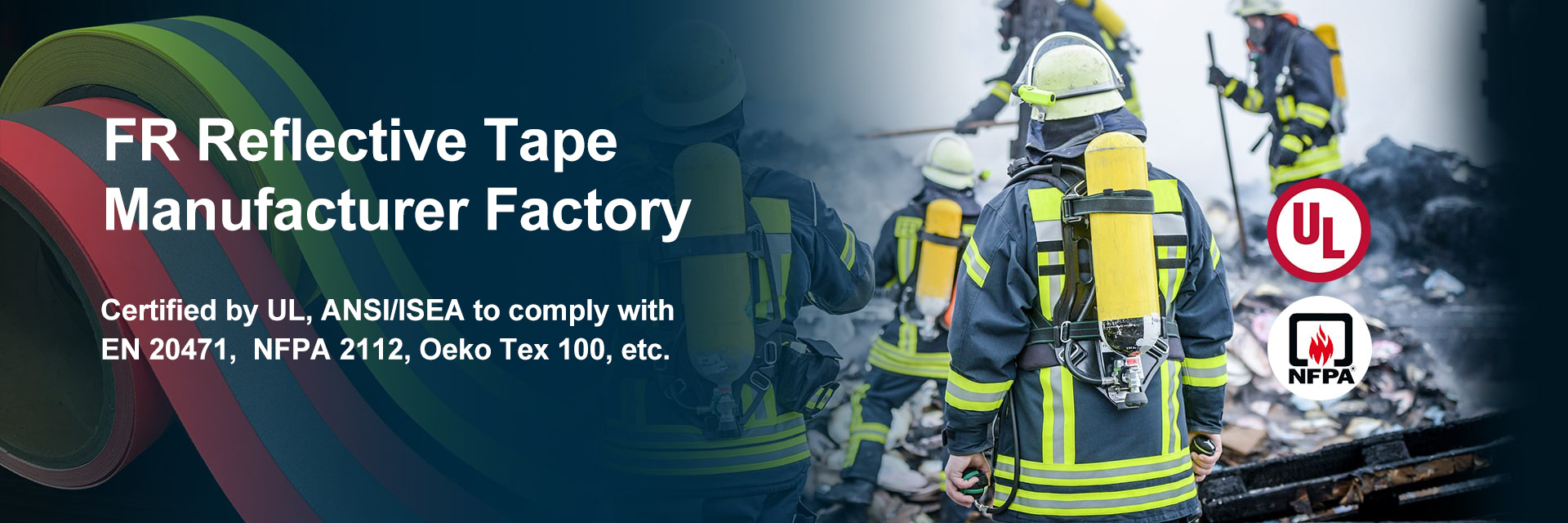
As a professional reflective material manufacturer, YSM has always been committed to providing high-quality flame retardant reflective tape to meet safety needs in different scenarios. In order to ensure that the product meets international standards in terms of performance, safety and environmental protection, our flame retardant reflective tape has passed multiple authoritative certifications such as EN 20471 Class II standard, ANSI/ISEA 107-2020 standard, NFPA 2112 standard and OEKO-TEX Standard 100.
UL 94 Plastic Flame Retardant Grade Certification
UL 94 is a plastic combustion performance classification standard launched by Underwriters Laboratories (UL) in the United States, focusing on evaluating the self-extinguishing ability and burning dripping characteristics of materials under small-scale flames. The main test items and ratings are as follows:
| Grade | Test mode | Flame action time | Self-extinguishing requirements | Droplets | Typical application |
| HB | Horizontal burning | 30 s or to 100 mm | Burning rate < 75 mm/min or extinguished within 100 mm | Allowed | Plastic sheets, surface laminated materials |
| V-2 | Vertical burning | 2×10 s | Single residual burning ≤ 30 s, total residual burning ≤ 250 s | Ignition of cotton is allowed | Structural backing, thickness ≥ 3 mm |
| V-1 | Vertical burning | 2×10 s | Single residual burning ≤ 30 s, total residual burning ≤ 250 s | Not allowed | Scenarios where flame retardancy needs to be improved but cost is controllable |
| V-0 | Vertical burning | 2×10 s | Single residual burning ≤ 10 s, total residual burning ≤ 50 s | Not allowed | Key safety components, electronic housing |
Test process: First, the thickness S ≤ 13 mm The samples were pre-conditioned at 23 °C and 50% relative humidity for 48 h, and then a 20 mm high flame was applied to the bottom of the sample to record the burning and residual burning time, as well as whether the dripping material ignited the cotton.
Application Tips: For the plastic backing of reflective tape, at least V-2 level should be achieved; if used for high-end security clothing or electronic housing, V-0 or even 5VA level testing is recommended to cope with more stringent flame impact.
NFPA 2112 Flame Retardant Performance Certification for Protective Clothing
NFPA 2112 was developed by the National Fire Protection Association (NFPA) and focuses on the overall performance of flash fire protective clothing. It is closer to actual wearing conditions than UL 94. Its purpose is to minimize the area and severity of human burns in short-term high-temperature flash fire events.
Key Performance Indicators
- Heat Transfer Performance (ASTM F2700): Measures the amount of heat transfer under a heat flux of 84 ± 2 kW/m², requiring interval test HTP ≥ 6 cal/cm² (25 J/cm²) and contact test HTP ≥ 3 cal/cm² (12.6 J/cm²).
- Vertical Burning (ASTM D6413): After simulating a 12 s flame, measure the afterburning time, afterflame time and charring length, and require 100 cycles of washing before and after to ensure durability.
- Flash fire mannequin test (ASTM F1930): Use a mannequin with sensors to simulate 3 s, 84 kW/m² flame exposure, and predict that the second and third degree burn area must be ≤ 50%.
- Heat shrinkage and delamination (ASTM F2894): Evaluate heat shrinkage ≥ 10% in a 260 °C oven, and no melting, dripping, delamination or reburning shall occur.
Brief description of the test process
- Sample: Cut 300 × 300 mm clothing fabric and add seams to simulate the finished product.
- Pretreatment: Industrial washing 100 cycles and drying.
- Laboratory: Performed by a third-party organization certified by ISO 17025/17065. It is recommended to witness the scene and retain the video data of the whole process.
Applicable scenarios
Protective clothing for workers in petrochemical, refinery, and oil field.
Flame retardant reflective strips for military and special operation environments.
Quality Control
YSM flame retardant reflective tape uses 100% cotton or aramid substrate, which not only has excellent flame retardant effect, but also maintains structural integrity in high temperature and flame environments.
ANSI/ISEA 107-2020 Standard
ANSI/ISEA 107-2020 is the authoritative standard for high-visibility safety clothing (HVSA) in the United States, focusing on improving visibility under various lighting conditions during the day and night, while flame retardancy needs to be verified in parallel with other standards.
Three performance levels
- Class 1: Minimum visibility, suitable for unobstructed, low-risk scenarios.
- Class 2: Medium visibility, suitable for near-road construction and dusk work.
- Class 3: Highest visibility, for high-speed traffic and limited visibility environments.
Material and configuration requirements
- Fluorescent background fabric area: Class 2 ≥ 0.50 m²; Class 3 ≥ 0.80 m².
- Reflective tape area: Class 2 ≥ 0.13 m²; Class 3 ≥ 0.20 m².
- Strip position: Must wrap around the torso, and set horizontal or vertical reflective tape on the limbs.
New version highlights
- Delete the "Accessories" category.
- Added a high-visibility section for disposable protective clothing.
- Emphasized performance retention after testing: thermal cycling, water washing, and bending tests.
Practical advice: When choosing flame-retardant reflective tape, refer to the requirements of ANSI/ISEA 107-2020 for reflective performance and durability of reflective materials to ensure that the overall garment still meets the visibility level after the tape is applied.
EN 20471 Class II standard
EN ISO 20471:2020 is the European standard for high-visibility clothing developed by the International Organization for Standardization (ISO). Class II belongs to the medium-risk visibility level:
Class II application scenarios: public road traffic speed ≤ 50 km/h, such as urban road maintenance, express delivery, and express riders.
Area requirements:
- Fluorescent background fabric ≥ 0.50 m².
- Reflective tape ≥ 0.13 m².
Chroma and brightness: Fluorescent yellow-orange, fluorescent yellow-green or fluorescent red must meet the chromaticity coordinates and maintain ≥ 50% of the initial brightness after sunlight, washing and friction.
Test method: The background fabric must pass the ISO 105-CO6 color fastness test, and the reflective tape must pass the EN ISO 20471 Appendix B Reflective coefficient test, and the reflective performance must be tested after 10 washes and 10,000 bends.
Tip: If the reflective tape is used on safety clothing for the European market, make sure the material label clearly states "EN ISO 20471:2013 Class II" and attach a qualified test report.

OEKO-TEX Standard 100 Certification
Although the main focus is on flame retardancy and reflectivity, the control of chemical safety and human health is equally critical. OEKO-TEX Standard 100 is the most widely recognized textile safety certification in the world, testing for > 1,000 hazardous substances, divided into four product categories:
- Product Category II: Textiles that come into direct, large-area or continuous contact with the skin (such as workwear fabrics, close-fitting linings).
- Detection range: heavy metals, phthalates, formaldehyde, pesticide residues, allergenic dyes, etc.
- Qualification requirements: All components - including adhesive layers, coatings, and adhesives - must be tested separately.
- Validity and review: The label is valid for 12 months, and the limit value is updated and the sample is re-tested every year.
Operation points: When selecting the coating and formulation of flame retardant reflective tape, give priority to using substrates and chemical additives that have passed OEKO-TEX 100 to ensure that the entire tape meets the synchronous environmental protection and safety standards when it leaves the factory.
Comparison and selection guide of five major certifications: how to balance scenarios, performance and cost
| Certification | Main indicators | Application scenarios | Cycle & cost | Key tips |
| UL 94 | Burning rate, residual combustion & dripping | Plastic backing, electronic components | 4–6 weeks; medium | ≥ V-2; key parts are selected V-0/5VA |
| NFPA 2112 | Heat transfer, human model burn rate | Petrochemical, flash fire risk environment | 6–8 weeks; high | Simultaneous ASTM F2700/F1930 test |
| ANSI/ISEA 107 | Background & reflective band area | North American road maintenance, night construction | Self-declaration or test; low-medium | ≥ Class 2; dual verification of reflective and flame retardant |
| EN ISO 20471 | Fabric & re-reflective performance | European roads and public facilities | 4–6 weeks; medium-high | Class II ≥ 0.50 m² / 0.13 m² |
| OEKO-TEX 100 | Limits of harmful substances | Workwear and close-fitting materials in contact with the skin | 2–4 weeks; low–medium | Prefer chemical safety substrates & additives |
Selection suggestions
- Clarify regulatory requirements: first confirm the target market regulations, such as UL 94+NFPA 2112 in the United States and EN ISO 20471 in Europe.
- Focus on core performance: if only reflective prompts are required, ANSI/ISEA 107 can be selected; if flash fire protection is required, NFPA 2112+UL 94 double insurance is used.
- Balance cost and schedule: important projects start testing 2–3 months in advance, and non-critical components can use self-declaration or internal verification.
- Environmental protection and health in parallel: any chemical coating or adhesive, give priority to OEKO-TEX 100 certified materials to reduce occupational health risks.

Certification test preparation and practical operation process
Project planning
- Clarify the required standards and certificate names.
- Make a schedule: sample preparation → lab scheduling → result issuance → report review.
Sample preparation
- Cut according to standard requirements: UL 94 (125×12.7×S mm), NFPA 2112 (300×300 mm), high-visibility fabrics (≥ 0.50 m² blocks).
- Record batch, thickness, formula, production date.
Pretreatment and pre-test inspection
- UL 94: 48 h environmental humidity conditioning.
- NFPA 2112: 100 wash cycles.
- EN ISO 20471: 10 wash cycles, Xenon light aging.
- OEKO-TEX: Different auxiliaries are tested separately.
Select a laboratory
- Confirm laboratory qualifications (CNAS, ILAC, ISO 17025/17065).
- Negotiate quotation and witness arrangements.
Testing phase
- Sample delivery: Attach technical specifications and process parameters.
- Process supervision: Remote or on-site witnessing to ensure that test conditions meet standards.
Report interpretation and improvement
- Compare with standard limits and mark unqualified items.
- Fine-tune problematic formulas or processes and submit again.
Certificate acquisition and management
- Apply for a certificate after receiving a qualified report.
- Establish electronic and paper files.
- Display the certificate number and QR code in a prominent position on the product manual, packaging and official website.
Conclusion and action suggestions
Professional certification is not only a way to "follow the rules", but also a tool for "seeking development". Through systematic and scientific multi-standard evaluation, you can:
- Strengthen brand endorsement: authoritative certificates bring customer confidence and help bid for large projects.
- Optimize product structure: Provide UL 94, NFPA 2112, ANSI/ISEA 107, EN ISO 20471 Class II and OEKO-TEX 100 five-in-one or split combination solutions for different scenarios.
- Improve supply chain efficiency: Standardize the testing process to make quality management, production monitoring and market access closely linked.
- Achieve sustainable development: Environmentally friendly materials and health and safety are equally important, in line with the global green supply chain trend.
Next steps:
- Internal evaluation: Sort out the gaps in existing product certification and formulate supplementary plans.
- Communication training: Organize R&D, quality, sales and marketing teams to interpret and promote standards.
- Cooperation expansion: Establish long-term cooperation with third-party laboratories with CNAS/ILAC qualifications.
- Market promotion: Integrate certificate information and test data into the official website, brochures and exhibition demonstrations to form a transparent advantage for the entire chain.
Let every meter of flame retardant reflective tape be on the road of high visibility, zero failure and safe escort, and become your core weapon to break through the market.
Related News

Reflective Webbing Factory: GB 8965 & Global Safety Standards
2026-10-08

Custom High Quality Luminous Film Factory
2026-09-09

Top 5 Flame Retardant Reflective Webbing Tape Manufacturer in Europe
2026-09-07
Messages
* Please be sure to leave your correct information so that we can contact you in time!
Contact us
Address: Wuli Industrial Zone, Jinjiang City, Fujian Province, China
Tel:+86 15980000890
E-mail:jerry@ysmlite.com
